Power Hacksaw Blades Recommendations
We supply the power hacksaw blade that gives you the optimal sawing result!
What should I watch out for when cutting with power hacksaw blades?
When using GUHEMA power hacksaw blades, we recommend observing a few simple but important ground rules for workpiece and saw blade in order to achieve optimal cutting results:
- Never start a cut on a corner.
- Always saw with coolant.
- Clamp the workpiece firmly so that it cannot twist.
- A new power hacksaw blade must be run in. Reduce the cutting pressure by approx. 50% during the initial period.
- Remove any mineral residues from the workpiece.
- Check the saw blade tension from time to time.
- Change your metal saw blade in good time! Best indicator: a marked increase in cutting time.
- Maintain your metal saw according to the manufacturer's specifications.
- Adjust the cutting pressure, cutting speed and number of teeth to the workpiece. The following diagram and table serve as a guide.
- When using positive tooth and Future blades, start at approx. 50% of the usual pressure. Once the saw blade is cutting across its full width, increase the pressure steadily, but without any humming noise becoming audible while sawing.

Rule of thumb:
Cutting speed÷ (2 × stroke length (m))= strokes/min
Which teeth per inch, cutting pressure and stroke rate for which material?
Recommended cutting data for solid material in normalised condition for GUHEMA power hacksaw blades, based on a stroke length of 200 mm.
For tubes and profiles, reduce the cutting pressure according to the wall thickness.
| Material | TPI for material dimensions | Cutting speed | Blade / | |||||||
|---|---|---|---|---|---|---|---|---|---|---|
| Designation | up to | over | Cutting pressure | depending on material thickness | Grade | Tooth form | ||||
| 30 mm | 50 mm | 100 mm | 200 mm | 200 mm | Strokes / min | m / min | ||||
| Unalloyed steels/structural steels – Case-hardening steels, e.g. | ||||||||||
| St37-C10-C15 | 10-8 | 8-6 | 6-4 | 4-3 | 2-1,5 | low | 60-100 | 24-40 | Super HSS | regular |
| St50-St60 | 10-8 | 8-6 | 6-4 | 4-3 | 2-1,5 | up to medium | 60-100 | 24-40 | Super HSS | regular |
| Quenched and tempered steels, e.g. | ||||||||||
| C35-C45-C60 | 14-10 | 8-6 | 6-4 | 4-3 | 2 | medium | 55-80 | 22-32 | Super HSS | regular |
| CK45-40MN4 | 14-10 | 8-6 | 6-4 | 4-3 | 2 | medium | 55-80 | 22-32 | Super HSS | regular |
| 34CrNiMo6-42CrMo4 | 14-10 | 8-6 | 6-4 | 4-3 | 2 | medium | 45-50 | 18-20 | Super HSS | regular |
| Alloy tool steels, e.g. | ||||||||||
| 125Cr1-115CrV3-100CrMo5 | 14-10 | 8-6 | 6-4 | 4-3 | 2 | medium | 40-60 | 25-40 | Super HSS | regular |
| X210Cr12 | 14-10 | 8-6 | 6-4 | 4-3 | 2 | medium | 25-40 | 10-16 | Super HSS | regular |
| High-speed steels, e.g. | ||||||||||
| ABC III-DMo 5 | 10-8 | 8-6 | 6-4 | 4-3 | 2 | medium | 25-40 | 10-16 | Super HSS | regular |
| EMo 5 V 3-B18 | 14-10 | 8-6 | 6-4 | 4-3 | 2 | & higher | 25-35 | 10-14 | Brillant | regular |
| Stainless steels, e.g. | ||||||||||
| V2A-V4A | 14-10 | 8-6 | 6-4 | 4-3 | 2 | Special instructions | 25-37 | 10-15 | Brillant | positive |
| Special alloys, e.g. | ||||||||||
| Hastelloy-Inconel | 10-8 | 8-6 | 6-4 | 4-3 | 2 | Special instructions | 20-25 | 10-16 | Brillant | positive |
| Nimonic-titanium | 10-8 | 8-6 | 6-4 | 4-3 | 2 | Special instructions | 10-13 | 4-5 | Brillant | positive |
| AMPCO 18-20 | 10-8 | 8-6 | 6-4 | 4-3 | 2 | medium | 45-50 | 18-20 | Brillant | regular |
| AMPCO 21-26 | 10-8 | 8-6 | 6-4 | 4-3 | 2 | medium | 40-45 | 16-18 | Brillant | regular |
| Cast steel | 14-10 | 8-6 | 6-4 | 4-3 | 2 | medium | 50-70 | 20-28 | Super HSS | regular |
| Cast iron | 14-10 | 8-6 | 6-4 | 4-3 | 2 | medium | 50-70 | 20-28 | Super HSS | regular |
| Special bronzes | 10-8 | 8-6 | 6-4 | 4-3 | 2 | medium to high | 50-62 | 20-25 | Brillant | regular |
| Non-ferrous metals | ||||||||||
| Aluminium/bronze/brass | 8 | 6 | 4 | 3 | 2 | low | 80-120 | 32-48 | Super HSS | regular |
Which material thicknesses are GUHEMA Future blades suitable for?
| TPI | Description |
|---|---|
| 8/10 | Material thicknesses of 8-30 mm |
| 6/8 | Material thicknesses of 20-50 mm |
| 4/6 | Material thicknesses of 50-100 mm |
| 3/4 | Material thicknesses of 70-150 mm |
| 2/3 | Material thicknesses over 150 mm |
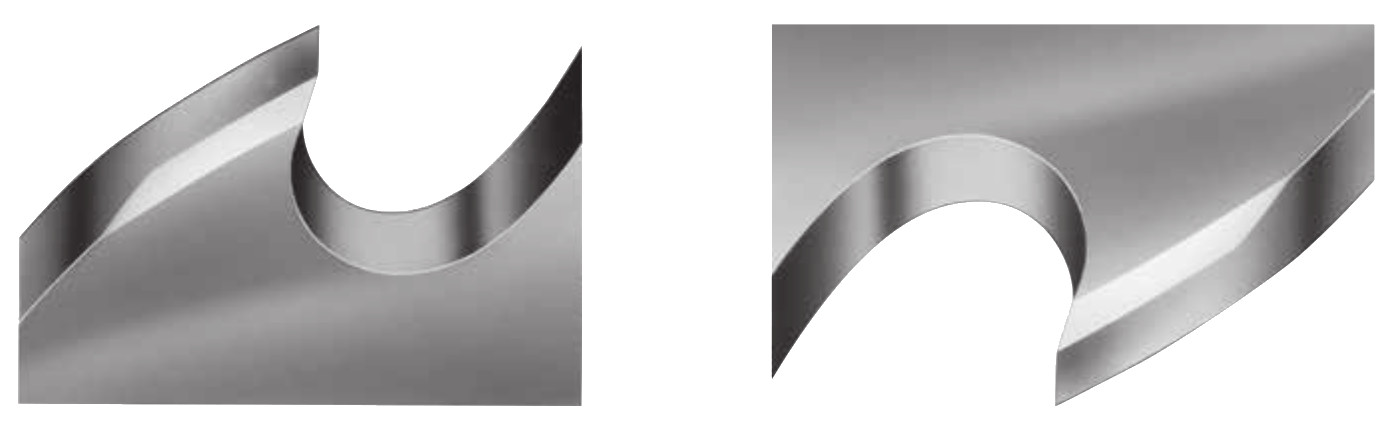
What are the benefits of side chamfering on coarse teeth?
Take advantage of our side chamfer grinding. You get the cleanest cutting results. The chamfer prevents premature tooth breakage, and the easy chip curl reduces the load on blade and machine → metal saw blade and machine last longer.
On request, we will gladly provide side chamfer grinding up to 6 TPI. Just ask us!
What causes common sawing problems?
Why do teeth break off?
Possible causes:
- Too few teeth selected. At least 3 teeth should be engaged at the same time, including on tubes and profiles.
- Cut started on a corner.
- Workpiece clamped incorrectly.
Why does the saw blade break?
Possible causes:
- The kerf closed up and jammed the saw blade.
- Incorrect blade tension.
- Toothing too coarse for the workpiece.
- Cutting pressure too high.
- Worn guide bearings in the machine.
Why do the teeth go blunt prematurely?
Possible causes:
- Toothing too fine.
- Cutting speed too high for the workpiece.
- Pressure too high (increased tooth load) or too low (teeth rub over the workpiece instead of lifting a chip).
- Insufficient/misdirected saw blade cooling.
- Wrong saw blade grade selected.
- Saw blade not lifted on the return stroke.
Why does the cut run off?
Possible causes:
- Incorrect blade tension.
- Workpiece not clamped firmly enough.
- Cutting pressure too high.
- Worn guide bearings in the machine.
Didn't find your answer?
Then talk to an expert! Contact our application advice team at+49 (0) 2191 88 67-20.